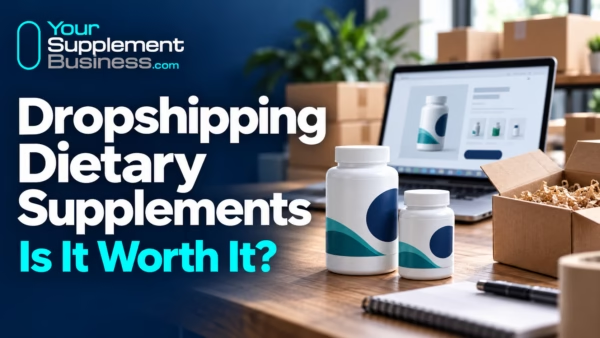
Dropshipping dietary supplements can look like an attractive way to start a business. You list products on your website, customers place orders, and a supplier dispatches those orders for you.
You may avoid purchasing a large batch of stock upfront. But that convenience needs to be weighed against product costs, service fees and the amount of control you have over fulfilment.
In the video below, Mark shares his experience of selling dropship supplements for 18 months, including why he would approach the decision differently today.
Supplier prices and fees mentioned in this video reflect Mark’s experience at the time. Obtain current quotations before budgeting.
What Is Supplement Dropshipping?
Dropshipping is a fulfilment arrangement in which a supplier ships products directly to your customers on your behalf.
It is different from deciding whether to sell a custom formula or a private-label supplement.
These choices answer separate questions:
| Decision | What you are choosing |
|---|---|
| Custom formula or private label | Which product you will sell and how it is developed |
| Dropshipping or holding inventory | How stock and customer orders will be handled |
A supplier might offer an existing private-label formula with dropshipping. Another arrangement might involve manufacturing your products in advance and storing them with a fulfilment provider.
Ask exactly how the service works. “Dropshipping” does not tell you everything about stock ownership, branding or payment terms.
Why Dropshipping Appeals to New Supplement Brands
The main attraction is a smaller initial commitment to inventory.
Depending on the supplier, you may be able to pay for products as orders arrive rather than purchasing a batch before you have customers.
That can be useful when you want to:
- Test demand for a product.
- Avoid storing stock yourself.
- Launch with limited upfront inventory spending.
- Add selected products without buying a batch of each.
However, a lower inventory commitment does not necessarily mean a lower overall cost.
You still need a website, suitable product information, a way to attract customers and a plan for handling enquiries, returns and complaints.
1. Compare the Full Cost of Dropshipping Dietary Supplements
In the video, Mark describes finding that the convenience of paying per order came with higher costs.
The exact difference depends on the supplier and product. Obtain current quotations rather than assuming every dropshipping service uses the same markup.
Compare:
- Product cost per bottle.
- Label printing and application.
- Account setup or onboarding fees.
- Monthly subscriptions.
- Picking, packing and packaging charges.
- Postage.
- Returns and replacement costs.
- Any minimum charges or additional service fees.
Check whether the company manufactures the products, fulfils orders itself or coordinates other suppliers. A service provider can add value, but you need to understand what you are paying for.
A Simple Comparison
Suppose a bulk supplier quotes $5 per bottle with a minimum order of 50 bottles. That would mean spending $250 on inventory before other expenses.
A dropshipping quotation should be compared against that option using the same product, destination and order size.
The useful question is:
How much remains from a typical order after all variable costs?
Include customer discounts, payment fees and marketing costs in that calculation. Revenue alone will not tell you whether the arrangement is sustainable.
2. Check Product Presentation Before Customers See It
One of Mark’s strongest objections came from an order he placed for himself.
He reports receiving bottles with creased labels. For him, that raised a concern about how customers would experience the brand when he could not inspect their orders before dispatch.
That is his experience with a particular supplier, rather than proof that every dropshipping service performs poorly.
The practical lesson is to test the complete fulfilment process yourself.
Place sample orders and check:
- Label alignment and print quality.
- Bottle seals and packaging condition.
- Whether the correct product arrives.
- Dispatch time and tracking updates.
- Packing slips and branding.
- How the supplier responds when something goes wrong.
A good product mockup cannot compensate for a poorly presented delivery.
3. A Large Catalogue Is Not a Marketing Strategy
Dropshipping may make it easier to list many products. But having access to a catalogue does not mean every item belongs in your store.
Each product needs accurate information, suitable images, customer support and a reason for your audience to buy it.
Mark’s preferred approach is to start with a hero product: one core offer that gives your marketing a clear focus.
Supporting products can be added when they serve the same audience and have a clear role. Avoid recommending combinations simply to increase order value; suitability and potential ingredient overlap need consideration.
Read more about choosing a hero product for your supplement business.
4. Give Customers a Reason to Choose Your Brand
If several businesses sell similar formulas, your logo alone may not provide a compelling difference.
Think about the customer you serve and the experience you provide.
Your positioning might centre on a clearly defined audience, a focused product range, helpful education or particularly responsive customer support.
Make that positioning specific and honest. Claims about sustainability, ingredient sourcing or manufacturing standards should reflect what you can substantiate.
A focused brand is easier to understand than a general store trying to appeal to everyone.
5. Consider Small-Batch Private Label as an Alternative
Mark’s preference after his dropshipping experience is to investigate a smaller private-label order before committing to a dropshipping service.
That may give you:
- More opportunity to inspect stock.
- Greater control over presentation.
- A potentially lower product cost.
- Flexibility over your fulfilment arrangements.
The trade-off is that you commit money before selling and take responsibility for unsold stock.
Minimum order quantities, prices and available services vary. Holding inventory also means planning suitable storage, stock rotation and dispatch.
For a related comparison, see our guide to custom formulas versus private-label supplements.
Is Dropshipping Supplements Worth It?
It can be, when the supplier’s service, pricing and product range suit your business.
Before deciding, ask:
| Question | Why it matters |
|---|---|
| What is the full cost per order? | Reveals what remains after fulfilment and product costs |
| Who controls the inventory? | Clarifies availability and ownership |
| Have I tested sample orders? | Shows the experience customers are likely to receive |
| What happens when an order is wrong? | Establishes replacement responsibilities and costs |
| Can I access suitable product documentation? | Supports product checks and market-specific review |
| Can I move to bulk purchasing later? | Helps you assess future flexibility |
Mark’s Takeaway: Start Focused and Check the Details
After 18 months of selling dropship supplements, Mark would favour investigating a small order of one core product rather than launching a large catalogue through a dropshipping service.
Your decision may be different. The important step is to compare the full costs, test the supplier and decide how much control your brand needs.
If you need help assessing your options and planning a launch, book a supplement business consultation.
You can also explore our guide to the cost of starting a supplement business.