
If you’re facing the task of writing your first custom dietary supplement formula, you probably have one big question: where do I start?
When I started, I went the long way around it. Eventually, I developed a spreadsheet method that helped me narrow down the ingredients worth researching.
Instead of trying to understand every ingredient available, I start by examining competing products. That gives me a manageable shortlist and a clearer direction for my research.
In the video below, I walk through that process and explain two concepts I call “keyword ingredients” and “lighthouse ingredients.”
Start by identifying your competitors
The first thing I do is identify seven to ten competing products.
For the demonstration in the video, I use a hypothetical formula called “Ultra Sharp” for the focus supplement market. I compare five example products to keep the walkthrough manageable.
You could start with the products appearing on the first page of Google. Another option is to search Amazon for the type of supplement you want to create and look at the bestselling products.
Once you have your competitors, you need their ingredient information.
Look for the Supplement Facts panel on their websites or in their Amazon product images. If you can’t find it, try searching Google Images for the product name followed by “Supplement Facts.”
Sometimes a review site, blogger or customer has photographed the label, even when it isn’t easy to find on the brand’s website.
Build a spreadsheet of their ingredients
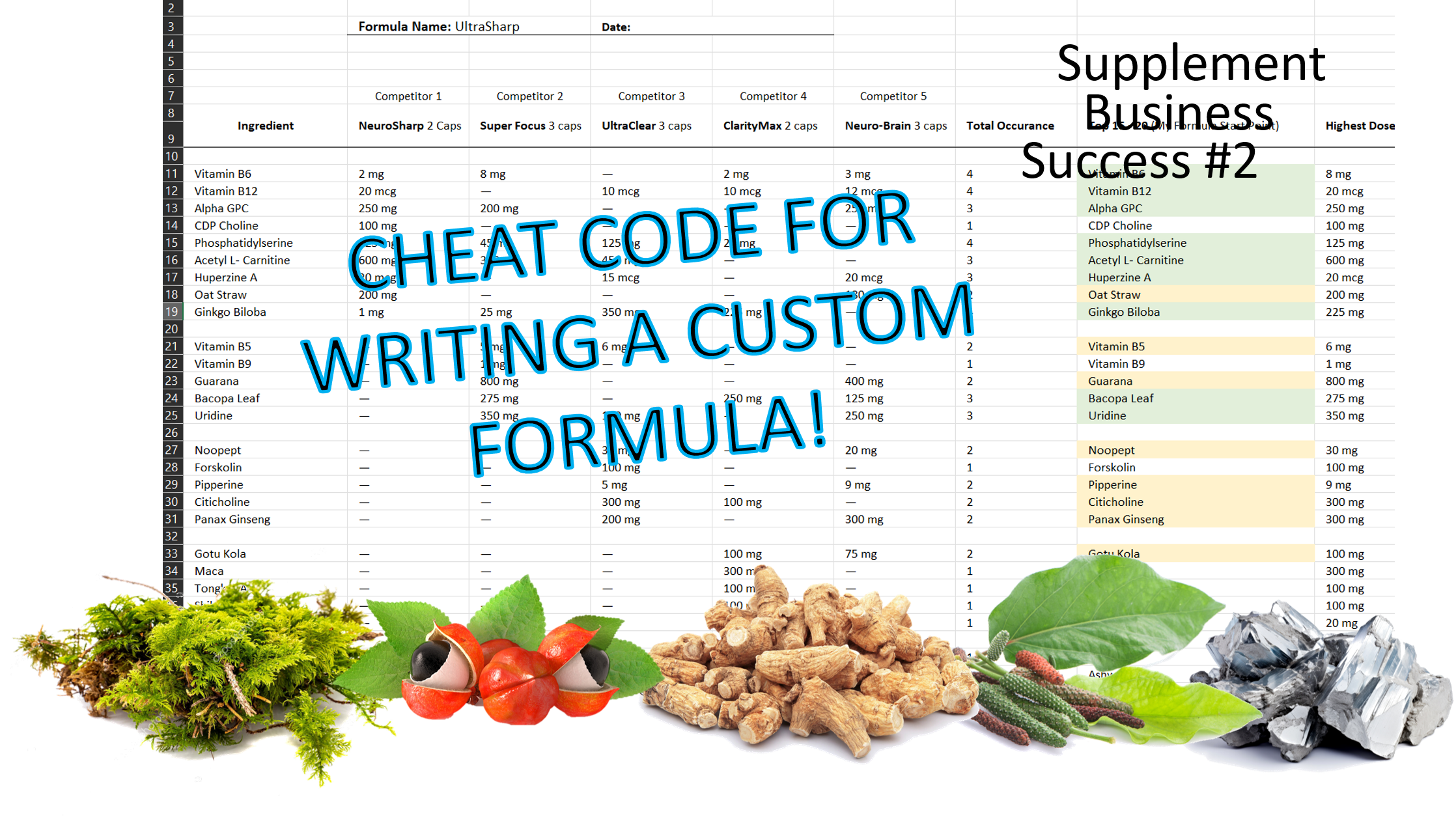
Next, put the ingredient names down the left-hand side of a spreadsheet. Give each competing product its own column.
Start with the first product and enter its ingredients and declared amounts.
When you move to the second product, some ingredients will already be on your list. Add any new ingredients as additional rows.
Keep going until you have entered all the products you are comparing.
You should now have a spreadsheet showing which ingredients appear in each formula and the amounts used.
You could simply put ticks in the boxes to show whether an ingredient is present. However, I prefer to record the amounts at the same time because it saves work when I return to investigate serving quantities.
Find the ingredients that keep appearing
Once everything is in the spreadsheet, look along each ingredient’s row and count how often it appears.
If an ingredient is in four of the five products, it goes on my research shortlist. In the video, I mark these frequently recurring ingredients in green.
This is how I make the research more manageable.
Instead of starting with an enormous number of possible ingredients, I might now have a list of around 20 to 30 to investigate.
If I have time, I want to research the whole list. But if I need to narrow it further, the ingredients appearing most often give me somewhere to start.
Don’t overlook the less common ingredients
An ingredient appearing in only one product may still deserve attention.
In my example, one competitor includes ingredients that aren’t in the other formulas. I wouldn’t dismiss them just because they are less common.
There is a lot of repetition in this industry. Some companies keep using familiar combinations, while another business may have investigated something different.
I want to understand why those ingredients are there. Perhaps there is something worth exploring.
My aim is to research the category and find opportunities to build a better formula.
Research your shortlist
Once I have my shortlist, I start learning about the ingredients.
Two resources I have used are Examine and Healthline.
When I want a more detailed look at the research, I go to Examine. I find it useful for exploring what an ingredient has been studied for, the strength of the evidence and the details of individual studies.
When I want an easier starting point, I use Healthline. It can help me get an overview of an ingredient and follow links to the research being discussed.
As I work, I make notes about:
- Why I am considering the ingredient.
- What the research investigated.
- The ingredient forms and amounts studied.
- Safety and tolerance considerations.
- Links to the original studies.
The spreadsheet helps me decide where to look. The research helps me understand whether an ingredient deserves a place in the proposed formula.
Save your notes for the website
I recommend keeping your research organised as you go.
Later, when you write your website copy—or ask someone else to write it—you will have a record of why you chose the ingredients.
You can explain your thinking and provide the research you reviewed, rather than starting again from scratch.
I also discuss linking to supporting studies in the video. Keeping those references together makes it much easier to return to the original information when developing your content.
Think about a “keyword ingredient”
A “keyword ingredient” is my term for an ingredient people already recognise or search for.
I once worked with a client who wanted a familiar ingredient included in a formula because their marketing research suggested customers were looking for it.
My initial reaction was to question whether it belonged in the product. Their argument was about reaching customers: they wanted an ingredient people would recognise when they discovered the formula.
That conversation made me think more about the connection between formulation and marketing.
You could have a formula you believe in, but you still need to explain it to people. If every ingredient is unfamiliar, customers may struggle to understand what they are looking at.
A recognisable ingredient can give them a point of connection. It is something to consider while researching the market and deciding how to communicate your product.
Think about a “lighthouse ingredient”
The other concept I discuss is a “lighthouse” or “beacon” ingredient.
This comes back to retention. Getting someone to buy once is one challenge; giving them a reason to return is another.
Some supplements involve what I call a leap of faith. A customer may take the product without noticing an immediate difference.
My lighthouse concept is about an ingredient associated with a noticeable experience—something the customer can connect with taking the product.
In the video, I share how customer feedback influenced my thinking about this. Sometimes people described aspects of their experience that became particularly meaningful to them.
That is why I think about the customer’s experience alongside the ingredient list and the product’s positioning.
Look for a story in your research
As you investigate your ingredients, look for a story.
I remember reading about a skincare company whose marketing was rebuilt around the history of one ingredient. Before that, the messaging focused on broad promises about beautiful skin and radiance.
The ingredient gave the business something more specific to talk about.
You may find a story in an ingredient’s background, your reason for choosing it or your own experience with it.
For me, researching the formula can also help uncover the story behind the product. That gives you something more meaningful to explain than a list of ingredients alone.
Work with your manufacturer
Your initial formula will need further development, and a manufacturer can help identify practical issues.
I have had manufacturers question proposed amounts and suggest changes.
For example, when I was working on a children’s drink formula, a manufacturer pointed out that one ingredient could make the water cloudy and another could make it bitter. They suggested alternatives.
Those are useful conversations. A formula on a spreadsheet is one thing; turning it into a product people can use is another.
Ask what formulation support your manufacturer provides and discuss the questions that arise from your research.
Start with the spreadsheet
You don’t have to begin by researching every ingredient under the sun.
Start with comparable products. Gather their ingredient panels, enter the information into a spreadsheet and look for patterns.
Research the recurring ingredients, investigate the less familiar ones and keep notes about what you find.
That process gives you a practical starting point and a clearer basis for developing your idea further.
Watch the video above to follow my spreadsheet demonstration.
Ready to create your own dietary supplement formula?
Need help turning your supplement idea into a formula? Book a free 15-minute consultation to discuss your product, where you are in the process, and how we can help with your formulation. Whether you’re starting from scratch or already have a draft formula, we can talk through your questions and the next steps.